
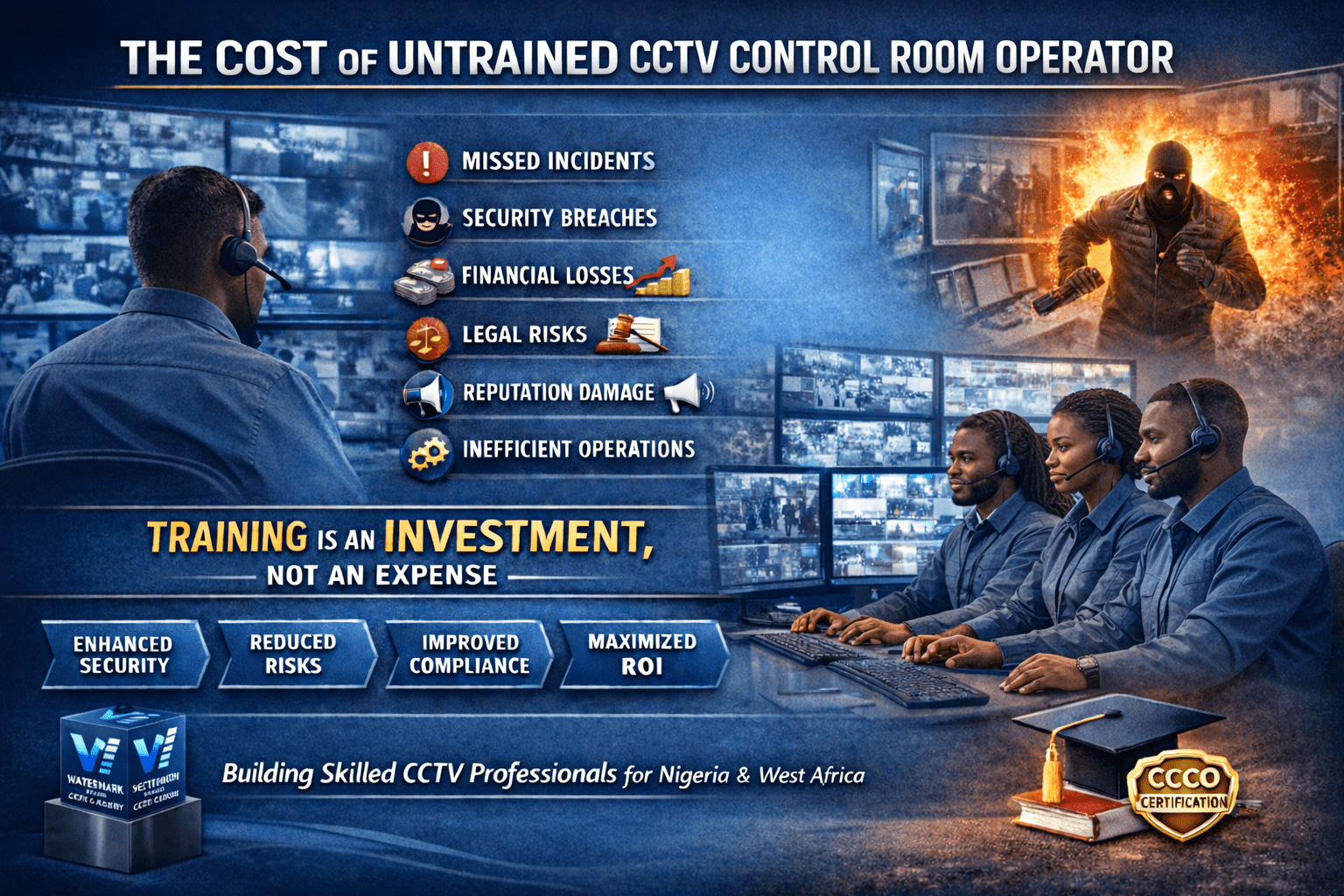
THE COST OF UNTRAINED CCTV CONTROL ROOM OPERATOR
In my more than a decade of hands-on experience within the corporate security industry, one persistent reality stands out: the average CCTV control room is often staffed by operators who have received little to no job-specific training in modern surveillance operations. In many cases, what passes for training is fragmented, superficial, and designed merely to satisfy compliance requirements rather than to build true operational competence.
This gap between technology investment and human capability is not just a procedural oversight – it is a critical vulnerability. When operators lack the skills to effectively observe, detect, verify, respond, and report in line with established Standard Operating Procedures, the consequences extend far beyond the control room. It is within this context that we must fully examine the true cost of untrained CCTV control room operators – a cost that many organizations often underestimate until it is too late.
In today’s evolving threat landscape, the CCTV control room is no longer a passive monitoring hub – it is a critical command centre for proactive security management. Organizations across banking, maritime, oil and gas, telecommunications, manufacturing, hospitality, and public infrastructure, etc. increasingly rely on surveillance systems to safeguard assets, people, and operations.
However, while significant investments are made in advanced surveillance technologies such as high-definition cameras, video analytics, access control integration, and remote monitoring systems one critical component is often overlooked: the competence of the CCTV Control Room Operator.
An untrained operator does not merely reduce system efficiency; they introduce measurable operational, financial, and reputational risks. The cost of this gap is often hidden until a major incident exposes it.
Further insight to some these cost:
1. Operational Cost: Failure to Detect and Respond
Modern CCTV systems are designed to observe, detect, verify, respond, and report. An untrained operator typically struggles across all five functions.
Practical Implications:
- Missed suspicious activities due to poor situational awareness
- Delayed response to security breaches
- Inability to prioritize incidents correctly
- Over-reliance on reactive rather than proactive monitoring
In high-risk environments such as a port facility or other critical infrastructure, even a few minutes of delayed response can escalate into major incidents, stowaway, armed attack, vandalism, or insider compromise.
2. Financial Cost: Losses, Liabilities, and System Underutilization
Organizations invest heavily in surveillance infrastructure, yet without trained operators, these systems become underutilized assets.
Direct Financial Costs:
- Theft and shrinkage due to undetected incidents
- Increased insurance claims and premiums
- Regulatory penalties in compliance-driven sectors
- Cost of incident recovery and investigation
Hidden Financial Costs:
- Wasted capital expenditure on underused technology
- Frequent equipment misuse leading to maintenance issues
- Inefficient incident documentation affecting legal proceedings
An untrained operator effectively turns a multimillion-naira surveillance investment into a “glorified viewing screen.”
3. Reputational Cost: Loss of Trust and Brand Damage
Security failures are rarely private. In today’s digital environment, incidents are quickly amplified through social media and public discourse.
Real-World Impact:
- Loss of customer confidence
- Negative media coverage
- Reduced investor trust
- Regulatory scrutiny
In sectors like banking and finance, and retail, a single preventable incident can erode years of brand equity.
4. Legal and Compliance Cost
CCTV operations are increasingly tied to data protection laws, chain of custody and evidence handling standards, and regulatory compliance frameworks.
Risks of Untrained Operators:
- Improper handling of video evidence
- Breach of privacy and data protection regulations such as the NDP Act, 2023 in Nigeria, or the GDP Regulation in Europe
- Failure to follow Standard Operating Procedures (SOPs)
- Weak incident reporting that cannot stand legal scrutiny
In legal disputes, poorly managed CCTV evidence can render critical footage inadmissible, exposing organizations to liability.
5. Human Factor Cost: Fatigue, Errors, and Poor Judgment
CCTV monitoring is a cognitively demanding task requiring:
- High levels of concentration
- Pattern recognition skills
- Decision-making under pressure
- Fatigue recognition and management
Untrained operators are more prone to:
- Surveillance fatigue
- False alarms or missed alerts
- Poor judgment during critical incidents
This not only reduces effectiveness but also increases burnout and staff turnover.
6. Strategic Cost: Absence of Intelligence-Led Security
A modern CCTV control room is not just for monitoring – it is a source of security intelligence.
Without proper training:
- Data is not analyzed for trends or patterns
- Incidents are not converted into actionable insights
- Preventive security strategies are not developed
This keeps organizations trapped in a reactive security posture.
Best Practices for Effective CCTV Control Room Operations
To mitigate these risks, organizations must adopt structured and professional approaches:
1. Competency-Based Training
Operators must be trained in:
- Surveillance techniques and behavioral detection
- Incident identification and escalation protocols
- Application of ODVRR framework
- Use of video management systems (VMS)
- Legal and compliance requirements
2. Standard Operating Procedures (SOPs)
Clearly defined SOPs ensure:
- Consistency in operations
- Faster and coordinated response
- Accountability and audit readiness
3. Continuous Professional Development
Security threats evolve—so must operator skills through:
- Refresher training
- Scenario-based simulations
- Technology updates
4. Performance Monitoring and Evaluation
Use KPIs such as:
- Detection accuracy
- Response time
- Missed incident
- Incident reporting quality
5. Integration with Broader Security Architecture
CCTV operations should align with:
- Access control systems
- Physical security teams
- Emergency response frameworks
Training: A Strategic Investment, Not a Cost Centre
Forward-thinking organizations must understand that training is not an expense, rather it is a force multiplier.
When operators are properly trained:
- Security incidents are prevented, not just recorded
- Technology investments yield full value
- Operational efficiency improves
- Risk exposure is significantly reduced
The return on investment (ROI) of training is seen in:
- Reduced theft / losses
- Improved compliance
- Improved stakeholders trust
- Enhanced organizational resilience
Bridging the Gap: Watermark Security CCTV Academy
Recognizing the growing gap between surveillance technology and operator competence, Watermark Security Consulting has established the Watermark Security CCTV Academy – a specialized training institution dedicated to developing world-class CCTV control room professionals across Nigeria and West Africa.
The CCCO Programme (Certified CCTV Control Room Operator)
The Academy’s flagship certification – CCCO (Certified CCTV Control Room Operator) is designed to align with global best practices while addressing local operational realities.
Key Value Delivered:
1. Practical, Industry-Relevant Training
Participants are trained to:
- Observe with purpose
- Detect anomalies effectively
- Verify incidents accurately
- Respond in line with SOPs
- Report with clarity and professionalism
2. Hands-On Operational Exposure
Training goes beyond theory, incorporating:
- Real-life scenarios
- Control room simulations
- Incident management exercises
3. Standardization of CCTV Operations
The program introduces structured methodologies that bring:
- Consistency
- Accountability
- Professionalism
4. Closing the Skill Gap
The Academy directly addresses:
- Lack of formal CCTV training pathways
- Inconsistent operator competencies
- Industry-wide performance gaps
- Operator’s confidence
5. Regional Impact
By training operators across Nigeria and West Africa, the Academy is:
- Raising the standard of CCTV operations
- Supporting organizations in achieving security excellence
- Contributing to safer communities and business environments
Conclusion
The cost of an untrained CCTV control room operator is far greater than most organizations anticipate. It is not just a matter of inefficiency, it is a direct threat to operational integrity, financial stability, and organizational reputation.
In an era where security risks are increasingly complex, the human element remains the most decisive factor. Technology alone cannot secure an organization, but competent people operating that technology can.
Organizations must therefore shift their mindset:
- From cost-cutting to capability-building
- From reactive monitoring to proactive security intelligence
- From unstructured operations to standardized excellence
Investing in professional training such as the CCCO certification offered by Watermark Security CCTV Academy is not optional; it is a strategic necessity.
The question is no longer whether to train, but whether you can afford not to.