
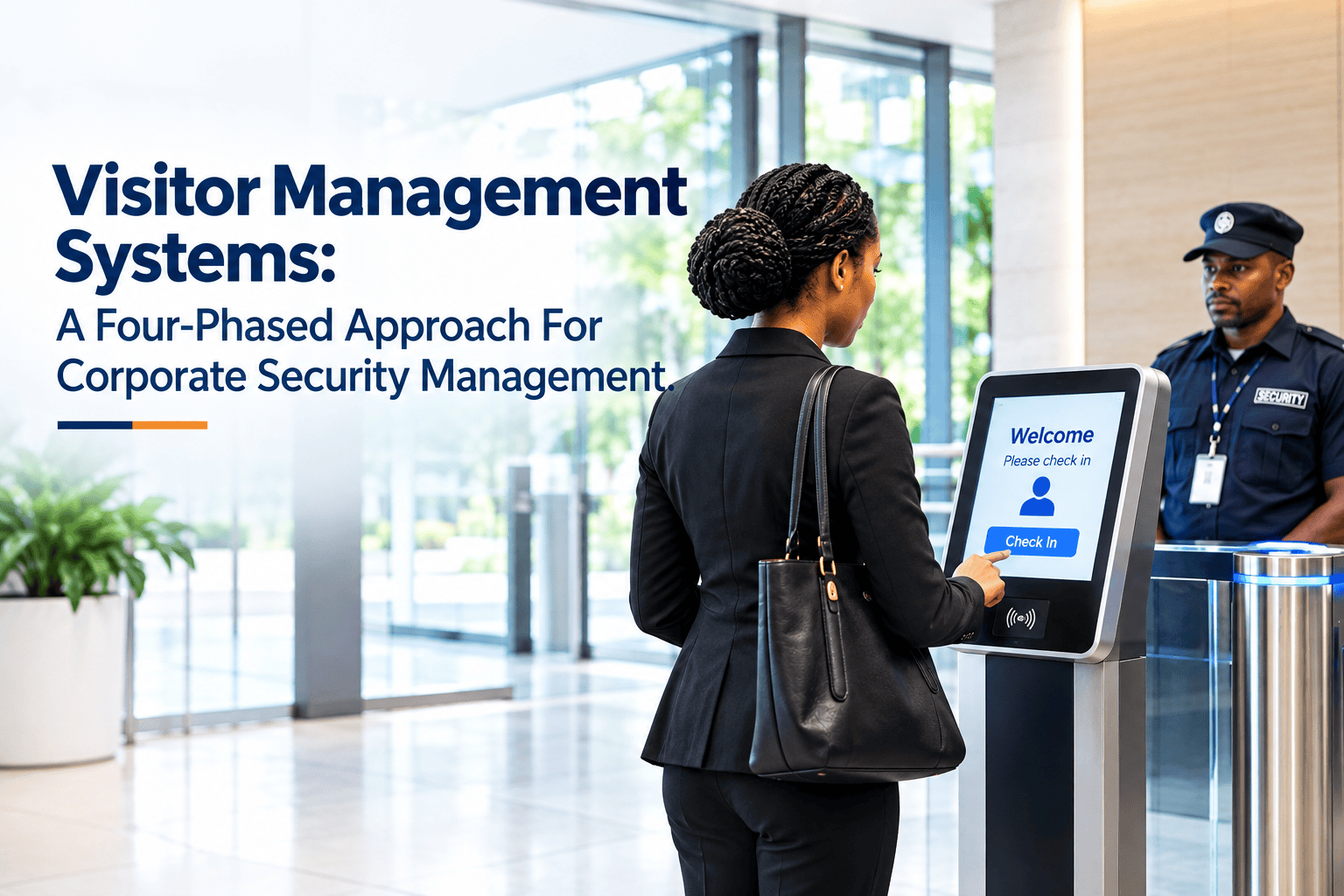
A Four-Phase Approach For Corporate Security Management
Every visitor who crosses your facility is, by definition, an unverified variable. They maybe Contractors, clients, auditors, couriers, interview candidates and prospective customers all have legitimate reasons to be on your premises, yet each one introduces peculiar security risk: unauthorised access, access to sensitive or restricted areas, theft of assets or information, safety incidents, and reputational damage. A well-designed Visitor Management System (VMS) converts that uncertainty into a controlled, documented and auditable process.
A VMS is not simply a logbook or a software platform. It is a structured programme of policy, people, process and technology that governs the entire visitor lifecycle in modern security management. In this article, we examine that lifecycle in four phases: pre-arrival, arrival, onsite and departure. For each, we shall outline practical standard practices that corporate security managers can implement with confidence.
Why Visitor Management Matters
A robust VMS serves several organisational objectives at once:
- Security: It prevents unauthorised access and ensures that only verified and authorized persons have access.
- Safety and emergency response: It provides an accurate, real-time record of who is on site, which is essential during evacuations and incidents.
- Accountability and compliance: It creates an auditable trail that supports investigations, regulatory obligations and data protection requirements.
- Professional image: A smooth, courteous process signals competence/maturity, and respect to every visitor.
The guiding principle is straightforward: security should be rigorous but never obstructive. The best systems protect the organisation while leaving the visitor with a positive impression. Enjoy the article.
Phase 1: Pre-Arrival
The strongest visitor controls begin before the visitor arrives. Pre-arrival is the phase in which risk is assessed, access is authorised, and expectations are set.
Standard Practices should include
- Require host-initiated invitations. No visit should proceed without a named internal host who takes responsibility for the visitor. Hosts should register visits in advance through the VMS, specifying the visitor’s name, organisation, purpose, date, expected duration and areas to be accessed.
- Classify visitors by risk. Not all visitors present equal risk. Define categories such as business visitor, counterparts, contractors, delivery personnel, VIPs and high-risk or restricted visitors, and attach a corresponding level of screening, etc..
- Conduct proportionate vetting. For contractors and visitors requesting access to sensitive or restricted areas, verify credentials, permits and, where appropriate, background information before approval.
- Communicate arrival instructions in advance. Send the visitor a confirmation containing the address, access control protocols, parking guidance, arrival time, required identification, items prohibited on site (such as weapons, cameras, drug/alcohol, pets, etc) and any safety requirements.
- Pre-register and pre-authorise. Where technology permits, issue a QR code or unique reference that speeds up check-in and reduces queues at the reception desk.
- Alert the front-line team. Reception and security officers should receive the day’s expected visitor list in advance so they can recognise and received the visitor efficiently, and so unannounced arrivals stand out immediately.
Phase 2: Arrival
Arrival is the first point of physical contact and the most critical control point. This is where identity is confirmed, authorization is validated, and the visitor is formally admitted into the facility’s security perimeter.
Standard Practices include
- Design a controlled reception environment. The reception area should separate the public space from the secure interior, with a clear point of control such as a desk, turnstile or access-controlled door. Visitors must never be able to bypass the check-in point.
- Verify identity against a valid government-issued ID. Match the document to the individual and to the pre-registered record. Where policy allows, capture the ID details or a photograph in the VMS.
- Confirm the visit with the host. The host should be notified automatically and should confirm before the visitor is admitted. Unannounced or unconfirmed visitors should not proceed beyond reception.
- Issue a clearly identifiable visitor badge. Badges should show the visitor’s name, photograph, host, date and an expiry time. Use colour-coding or distinct designs to differentiate visitor categories, and consider self-expiring badges that become void after the visit window.
- Obtain required acknowledgements. Visitors should sign confidentiality undertakings, safety briefings and site rules, preferably electronically within the VMS.
- Screen belongings where warranted. Apply bag checks, metal detection or equipment declarations in line with the site’s risk profile, and record any items brought in that must leave with the visitor.
- Cross-check against watchlists. Where legally and operationally appropriate, screen visitors against internal restricted-persons lists or previous incident records.
- Protect personal data. Collect only what is necessary, inform visitors how their information will be used and stored, and secure it in line with applicable data protection laws, including the Nigeria Data Protection Act or the law applicable in your region.
Phase 3: Onsite
Once inside, the visitor’s movement must remain consistent with the approved purpose. The onsite phase tests whether the controls established earlier actually hold.
Standard Practices should include
- Enforce escort policies. Define which visitor categories require continuous escort and which may move unescorted within designated zones. Hosts must understand that escorting is a duty, not a courtesy.
- Apply zoning and access restrictions. Segment the facility into public, controlled and restricted areas/zones. Visitor badges should not open doors to areas beyond the approved scope.
- Maintain visibility through CCTV and patrols. Control room or security operations centre operators and security officers should be able to identify visitors by badge and observe them in line with the site’s monitoring procedures.
- Train all employees to challenge. Every staff member should feel empowered, and be expected, to politely question anyone not wearing a badge or found in an unauthorised area. A culture in which challenge is normal is among the most effective deterrents available.
- Monitor visit duration. Overstays and unexplained extensions should trigger an alert to the host and security team.
- Manage contractors and long-term visitors separately. Contractors who attend for days or weeks need enhanced induction, task-specific permits and regular re-verification rather than repeated casual sign-ins.
- Maintain emergency readiness. The VMS should provide a live roll-call or exportable list of everyone on site, enabling rapid accountability during fire, medical or security emergencies. Brief visitors on assembly points and evacuation routes at check-in.
- Escalate and document exceptions. Any breach, such as tailgating, badge misuse or access to a restricted area, should be reported and recorded through a defined incident-reporting process.
Phase 4: Departure
Departure is often neglected, yet an incomplete exit process leaves gaps that undermine everything achieved in earlier phases. An unrecorded departure means an unknown person may still be considered “on site”, and an unreturned badge is a latent access risk.
Standard Practices should include
- Mandate formal sign-out. Every visitor must check out at reception, with the host or security officer confirming their departure. Automated sign-out reminders and host notifications improve compliance.
- Retrieve or deactivate badges. All physical badges should be collected and accounted for. Digital credentials should be automatically revoked at check-out or at the end of the visit window.
- Reconcile belongings and equipment. Verify that items declared on entry leave with the visitor, and that no company property, documents or devices leave without authorisation.
- Capture feedback where appropriate. A brief satisfaction question can reveal friction in the process and strengthens continuous improvement.
- Close the record. Ensure that the entry log, duration and any incidents are completed in the VMS, with final status confirmed.
- Review unclosed visits daily. Any visitor record without a recorded departure at end of the day should be escalated and investigated and resolved promptly.
- Retain and dispose of data responsibly. Define retention periods that balance investigative needs with data protection obligations, and securely delete records manually or automatic once they expire.
Cross-Cutting Standard Practices for Security Managers
Beyond the four phases, several enterprise-level practices determine whether a VMS succeeds over the long term.
- Establish a clear Visitor Management Policy. Document roles, responsibilities, visitor categories, escort rules, prohibited items and disciplinary consequences for non-compliance. Ensure senior management formally endorses it.
- Integrate your technology. Connect the VMS to access control, CCTV, HR directories, emergency notification and incident management systems to reduce manual effort and eliminate blind spots.
- Train and test your people. Reception teams, guards, patrol teams and hosts need regular training and scenario-based exercises. Technology fails without disciplined human execution.
- Maintain a manual fallback. Prepare a documented contingency for power failure, network outage or system downtime so that control is never lost.
- Audit and measure. Track metrics such as check-in time, unescorted-visitor incidents, badge return rate, overstays and unclosed records and system uptime. Conduct periodic audits and unannounced tests, such as mystery-visitor exercises, to validate performance.
- Balance security with hospitality. Courteous, efficient processes encourage compliance. If the system is complicated, people will find ways around it.
- Review continuously. Threats, regulations and business needs evolve. Revisit your VMS policy and procedures at least annually and after every significant incident.
Conclusion
Effective visitor management is a continuous chain of controls, and the chain is only as strong as its weakest link. By addressing risk before arrival, verifying identity and authority at the point of entry, supervising movement onsite, and closing the loop at departure, organisations gain full visibility over who enters their premises, why, where they go and when they leave.
For corporate security managers, the objective is not to create barriers but to build confidence: confidence that every person on your site is known, authorised and accounted for. When policy, people, process and technology work together across all four phases, the visitor management system becomes a quiet but powerful foundation of the organisation’s overall security posture.
Azubuike Nwenewo is the Founder of Watermark Security Consulting Ltd, with over 15 years of security management experience across multiple industry sectors.